My experience from Diversity Conference 2017!

Wikimedia Diversity Conference was organised by Wikimedia Sweden on 3rd November 2017 in Stockholm, Sweden. The conference was hosted for 2 days ( 2 days and a half for the Social event) with over 80 participants from 40 countries, representing various languages and communities. It was the time to meet old friends, make new ones and learn from their activities and projects in the Wikimedia Movement.

wikimedia_diversity_conference_2017_-_group_pic

The conference was started on 3rd November 2017 for the Social event in the Royal Armory Museum of Royal Palace of Stockholm. Volunteers gathered in the lobby of Stockholm Sheraton hotel and came to the Museum, the 15 minutes walk also helped in knowing people. After reaching the Museum, we were provided with registration kit. While going through my ID card, I found a bunch of papers were there inside. And going through the papers, I found a Bingo sheet, some instructions, and a page to note down the discussion. After attending the last 2 Wikimanias, I was aware of playing a Wiki Bingo, with a lot of words related to the movement being there in the puzzle, you have to mark it when the speakers during the Opening ceremony say that word. But in Diversity conference the Wiki Bingo was quite different with the Bingo sheet having questions, Person who is from Africa contributes to Wikipedia every day, uses Linux Operating system and others. I found it really amazing and a nice icebreaker activity. Diversity Conference being a conference with a small number of participants such activities helps in knowing people, being open and initiating a conversation with strangers. Later, when you get a Bingo, you have to form a group and discuss challenges and achievements of your community. I was also surprised by seeing the QR codes in the museum, which was later shared by the curator of Royal Museum about how Wikimedia Sweden and the museum have collaborated for the Open Knowledge movement and gave some brief about their work.

The main event started on 4th November with the opening speech by the Executive Director of Wikimedia Foundation, Katherine Maher. She started her speech saying “We are a community that believes in every single information need to be shared” saying that she explained How can we move towards knowledge equity, which was followed by a question she asked, Have we changed the world? And the crowd shouted “Yes”. By that time I had got the idea that the smaller is the conference the better you interact with more people and know from their work.

WikiCafer.PNG

During the conference, we were asked to sit in a group in such a manner that people from the same country should not be repeated and I believe we had one of the most diverse groups with Ivan, Carmen, Caroline, Reem and me, representing different projects and different communities. There was a good bonding in the group, our group actively took part in many discussions and we made some very good posters (As Ivan was in our team 😀 ) but everything changed when Ulrika introduced the WikiCafe, this was the first time I was part of revolving cafe concept. Within the 2-3 hrs of the WikiCafe session, I got a chance to interact with almost everyone present in the conference, we discussed the topics given, challenges we are facing and what could the solution for it. It not only helped in interacting with people, it also helped to know how people react to situations and deal in their community.  Also, I believe Mentimeter was one of the best things in the conference, where you could give your comments and suggestion live during the presentation, also you can see what others have suggested.

From using Wikimedia projects to engage vulnerable and underrepresented people into our movement, which I never thought that by teaching how to edit Wikiquote can make patients happier and feel good about themselves to how to make events more inclusive, make process map, Wikimedia Diversity has taught me a lot of things. It has also helped me to understand that the diversity doesn’t come with a single representation, it comes with a lot of people with new ideas and understandings, also diversity is not only about representation, there’s a various way of achieving it through content, participation, and others.

In the end, we understood how a commitment to diversity also needs to manifest itself in the governance structures of our movement organizations. “We” are a group of diversity activists who work on these issues in a volunteer and/or staff capacity.

Women’s History Month: Sambad collaborates with Odia Wikipedia for a Two Day Edit-a-thon

Sambad, in collaboration with Odia imageWikipedians, is organising a two day ‘edit-a-thon’ on March 18 and 19, 2017 to increase and improve  articles on women in Odia Wikipedia. Sambad, a regional language daily newspaper in Odisha, is among the most widely circulated and published newspapers as it is from eight key cities in the state, including the capital city of Bhubaneswar. The event will be organised in Sambad Bhawan Bhubaneswar with around 15-20 participants from different walks of life.
In 2011, a survey carried out by the Wikimedia Foundation found that only 8.5 percent of Wikipedia editors were female. Since then, awareness has risen and many have found the editor demographic imbalance to be a strong reflection of what the encyclopaedia does or does not cover, including how written language and discourse were constructed on the pages and how discussion flows on article talk pages.
The aim of this 100 Women Edit-a-thon is to create articles on 100 Women from Odisha, hailing from different fields of work. Mrutyunjaya Kar, Admin, Odia Wikipedia hopes that “through this edit-a-thon, Odia Wiki will get a new batch of female Wikimedians. I hope all the other Indic Wikipedias will replicate this to create and improve articles in their respective languages.” The Women’s Studies department of Utkal University and the archives of the Sambad newspaper are major resources for this edit-a-thon.
The program will run for two days with a batch of journalists from Sambad and Eastern Media along with local Wikipedians from the city. Tanaya Patnaik, Director of Eastern Media says, “Odisha and Odias have such rich history and accomplishments, but information regarding the same is limited on the Internet. Wikipedia has emerged as the most popular go-to information site and it is essential that we Odias as a community get together to make our presence felt on the web. We loved the idea of collaborating with Odia Wikipedia for an edit-a-thon aiming at creating 100 Wikipedia articles on Odia women achievers. This would be an incredible learning experience for us.”

WikiTungi Bhubaneswar, the city based community of Odia Wikipedians is taking the lead in organising the event. The first day of this edit-a-thon is dedicated to introducing Wikipedia and Wikimedia projects to the participants. Participants will also be taught how to create user accounts. The second day of this edit-a-thon is to create or improve articles from the 100 Women list. Tanveer Hasan, Program Manager, CIS-A2K added, “It is vital that Wikimedians take the lead in contributing to a gender sensitive Wikipedia. Edit-a-thons such as these are instrumental in doing so. These events must be carefully nurtured and an effort to follow-up should be made. According to Wikidata, Odia Wikipedia is among the gender balanced Wikipedias in terms of content. 20.6% of articles on Odia Wikipedia are related to women. In collaboration with Sambad for this initiative, Odia Wikipedians strive to bridge the gender gap and create an example in this movement.

Women’s History Month Wikidatathon

Second_Wikidatathon_01
Wikimedians translating labels of Wikidata. Image by User:Saileshpat under CC-BY-SA 4.0

The Odia Wikipedia was one of the first languages to have the article placeholder extension. The extension helps automatically generate content pages on Wikimedia projects displaying data from Wikidata. Since August 2016, a series of Wikidata label translation activities have been carried out in collaboration with the Wikimedians from Puri to help with this project. The goal of this project is to mark the presence of the Odia language in the Wikidata and to let the article place holder extension work flawlessly on the Odia Wikipedia.

On 12th March 2017, the second Wikidata-thon event was organized in Puri. The event was organized during the 7th WikiTungi Puri meetup. All total 8 Wikipedians joined for the event, 2 of them being female Wikimedians and 3 of them contributed through the mobile phone. The community members spent 2 and half hours translating the labels, descriptions in Wikidata and editing Wikipedia. 220 Labels and description were translated, and almost 26,762 Bytes were added into Wikidata. 

The event was focused on International Women’s history month and the labels translated were related to the articles created so far in Odia Wikipedia’s WHM editathon.  All the 220 labels were related to the Women personalities.  Wikipedians were taught about the Wikidata game and other tools of Wikidata. 

The Wikidatathon series has a target to translate at least 10,000 labels and description on Wikidata in Odia language by the end of 2017.

To do:

  • Engage the Wikipedians with the technical team and global contributors of  Wikidata to learn more about the project.
  • Bring at least 20 more editors into Wikidata.
  • One Wikidatathon mega event in the KIIT University to translate labels in Odia, Hindi and Bengali language.


Meet the youngest Odia Wikipedian.

Ashutosh Sarangi, a 6th-grade student age 11 years is the youngest contributor to the Odia Wikimedia projects. He is one of the most active contributors to Odia Wikisource. Ashutosh started contributing to Odia Wikisource after attending the secimg_5636

ond Odia Wikipedia workshop in Delhi in February 2015 and is going to complete his first anniversary in Odia Wikisource.

Being a student from Delhi, Ashutosh never studied his mother tongue Odia in his educational curriculum, because of family interaction, He was only able to speak in Odia. His mother Pankajamala Sarangi, another active user of Odia Wikisource helped Ashutosh in learning Odia by teaching him how to read and write the Odia language with the help of a Delhi-based organization called the Intellects.
Ashutosh says, contributing to Odia Wikisource helps in digitization of the Odia language and makes availability of Odia books on internet. He has edited “Semananka Piladina” and many other Odia books on Odia Wikisource. He uses Google OCR tool for his contribution which was taught to him on WhatsApp by Chinmayee Mishra, this OCR tool helped Ashutosh to contribute frequently to Wikisource.
As a member of Odia Wikimedia community, He recently attended the WikiConference India in August 2016, where he was the youngest Wikimedian among all the participants. He received a trophy from Natalia Tymkiv the Board member of Wikimedia Foundation for being the youngest volunteer in the conference. During WikiConference India, Ashutosh  got a chance to meet most of the Odia Wikipedians for the first time and also different language Wikipedians, which helped him gaining the knowledge of editing and better understanding of the movement. In future he wants to contribute more to the Odia Wikisource by digitizing more number of books and making it available for everyone. He also wishes to contribute and learn more on Wikipedia and Wikimedia Commons.

WikiTungi Bhubaneswar marks its first anniversary.

16707544_1434467369906227_2064389283176787287_o.jpg
Group photos of Wikipedians during the  anniversary dinner.

WikiTungi is a city based Wikipedia community formed to help the Wikipedians around the city to meet, share and learn from their experience in the Wikipedia movement. The Tungi meetups are mostly organised with the help of the volunteers. Odia community’s WikiTungi is a based in two cities, Puri and Bhubaneswar. While Wikimedians in Puri conduct meetups bi-monthly, Bhubaneswar Wikimedians meet once a month. In every meetup, Wikimedians exchange their resources with each other, helping address their doubts and queries regarding their problems and projects.Started in February 2016 the Bhubaneswar WikiTungi has marked its first anniversary on 9th February 2017. The community members of Bhubaneswar Tungi meet on every second Sunday of the month, and Durimg the first year anniversary eight community members from the Bhubaneswar Tungi met for a dinner to celebrate the volunteer practice of attending the WikiTungi meetups regularly. The community discussed on various ideas, and implementing them in the regular meetup of the Tungi, members of the community also shown their interest in organising the third WikiConference India in Bhubaneswar to spread more awareness on Wikipedia in Odisha. During the community meetup, Tungi members came up with few ideas to implement it as a best practice in the Wikipedia movement.

Some of them are listed here:

  • The Tungi members will invite one of the global community leaders for a Skype or hangout session.
  • Discuss the best practice from the global community and discuss them with the community.
  • Updating the minutes of the meeting and sharing them with the other community members.
  • Updating the learning and evaluation team about the new learning of the community every month.
  • The community will also send Postcards as a souvenir to the participants of the global community for the online sessions.

Bargarh manuscript digitization project.

manuscripts_dadhibamana_1
Mahishamardini sloka manuscript from the temple record room

Shree Dadhibamana Temple also known as the Srikshetra of Western Odisha is a 400 years old temple in Bargarh, Odisha. Being one of the prominent places for the religion practice in the Western Odisha, the temple has a record room with 250 ancient palm leaf manuscripts in Odia language, which dates back to 16th century. These palm leaf manuscripts consist the story  of Mahabharat, Ramayana, Skanda Purana and on the history of the temple.

The 400-year-old manuscripts are on the verge of erosion,  and  the Temple administration and Temple trust have preserved the pothi with the help of various chemicals. The process of preservation of the manuscripts was started in last 2-3 years where the student volunteers of different colleges in Bhatli helped the temple administration in identifying and storing the manuscripts.

Minati Sahoo, a well known social activist in Bargarh and few other journalist explained the importance of digitisation of the manuscript to the temple administration and took permission for digitising the manuscripts in the month of March. One of the Panda (Temple priest), Pandit Shri Goura Chandra Ratha released his book Jay Shree Dadhibamana under Creative Commons 4.0 license. A three day long digitisation camp will be organised in Bhatli for orienting the students on Wikipedia and the process of digitization, also the manuscripts will be digitised during that period.

After getting the confirmation from the Temple administration, an orientation program was organised in Imperial College, for orienting the students of the college about the digitisation process, also to introduce them the pothi digitisation which the students will take part.

imperial_college_orientation_01
Participants of Imperial College orientation program

With more than 40 participants the workshop was mainly a Wikipedia Orientation program for the students which provided an idea of the movement to them, and how they can use the digitisation skill for the preservation of the  language.

This digitisation project will bring different manuscripts into Odia Wikipedia, and will also help in spreading awareness about the digitisation of language in western Odisha. After scanning the manuscripts the Odia Wikipedia community will take help from the students for uploading, digitising and proofreading the manuscripts.

Odia Wikipedia reaching towards Western Odisha

 “Wikipedians reaching towards Western Odisha, to spread the digitization movement of Odia language with the help of Odia Wikipedia”

From the last 2-3 years, Odia Wikipedia community was able to organize workshops and outreach programs in different parts of the coastal and central Odisha. With over 38 active Wikipedians (As of 2016), Odia community is growing day to day and increasing its capacity in different parts of Odisha. The increase in the number of Wikipedians in western Odisha inspired the Wikipedians to conduct a workshop about Wikipedia in Sambalpur University.

On 27th November 2016 an orientation cum workshop program for Odia Wikipedia was organized for the students of Computer Science and Application department and Odia department in Sambalpur University. 57 participants consisting 30 male and 27 female participants including 5 faculty members attended the event. Dr. Chitta Ranjan Tripathy, the Vice-chancellor of the University was the guest of honor at the workshop. Three Wikipedians; Mrutyunjay Kar, Jnanaranjan Sahu, Sailesh Patnaik, and Nistha Ranjan Dash attended the workshop for mentoring the participants.

The workshop started with an introduction to Odia Wikipedia, digitization and Wikipedians present there by Dr. (Mrs) Sarada Baboo, Professor Computer Science, and Application department. The first two hours before lunch was for proper orientation of Wikimedia projects for the participants which included different Wikimedia projects, How to contribute in them, Wikipedia policies and Odia Wikipedia and its journey. Post lunch there was two hours training for participants on How to create accounts, articles, and other basic things. During the training session, almost 20 or above Wikipedians were able to create accounts.

Workshop in Sambalpur University was an important step to spread the awareness about Wikipedia movement in Western Odisha, This was the first workshop in Sambalpur University, and the second workshop in western Odisha after three years. Sambalpur University has almost 196 colleges under its affiliation in seven different districts in western Odisha. A regular follow up with University, faculties, and students will help in building an active community in western Odisha.

When I met GDG Bhubaneswar group.

On this June 14, Google Developer Group Bhubaneswar organized an extended I/O at Bhubaneswar. To my surprise, I found that there were more than 60 participants attending the conference. Basanta Kumar Maharana. TELL WHO HE IS was the speaker at the event. Basanta shared his memories from Google I/O 2015, San Francisco and demonstrated about the new launch and updates of Google. It was quite interesting for me to learn about various Google apps (?) kike Google cardboard, Android M, etc.


Odia Wikipedia meets Google Developer GroupIn an informal interaction with the host Sanjib Parida, he proposed me to speak about Odia Wikipedia there who came to know about the project while attending Odia Wikipedia’s 13th anniversary.

I started my talk by asking four questions to the audience:

  1. How many of the audience know about Wikipedia? (Everyone raised hands.)
  2. Who has copied content from Wikipedia for assignments? (People giggled about it, 50-60% of the participants nodded saying yes!)
  3. Who knows that anyone can “edit” Wikipedia? (the count reduced to about 10-20%)
  4. Who knows about Odia Wikipedia and contributes in creating and editing articles? (Only 4-5 people said yes, I found 2-3 of them being contributors to Odia Wikipedia)

I started my talk with a brief introduction to the history of Odia Wikipedia and how it was started in 2002 as one of the first four Indic languages Wikipedia projects along with Assamese, Malayalam, and Punjabi.

Odia Wikipedia was in dormant for the next eight years which was intervened when Wikimedians like Subhashish Panigrahi, Ashutosh Kar, Anshuman Giri, Mrutyunjaya Kar and others started building a community to improve and increase the content of Odia Wikipedia. Now we have grown as a community consisting about 17 active editors and the project has more than 8800 articles. The monthly page view of Odia Wikipedia has grown to more than 800,000 from merely 200,000 in 2011. We have three active Odia-language Wikimedia projects; Odia Wikipedia, the largest Odia online encyclopedia, online library Odia Wikisource, and multilingual online dictionary Odia Wiktionary. Odia Wikipedia community has not limited their work only in editing articles, rather has expanded into many other aspects of Odia computing. On the day of Odia Wikipedia’s 13th anniversary, it has launched a converter that can convert many non-Unicode encodings into Unicode. We have been supported by CIS-A2K for many activities to grow our community and the Odia Wikimedia projects. Like Odia Wikipedia, we have 20 more Wikipedia projects in other Indic languages and in over 288 languages globally. Hindi Wikipedia among all the Indic Wikipedia projects has the highest number of articles whereas Malayalam Wikipedia has the highest number of quality articles.

Odia Wiki1
Pictured above: Participants at the conference organized by the Google Developer Group at Bhubaneswar

Some of the state governments have been quite open and positive in bringing Wikipedia into academics. The Government of Kerala has introduced Wikipedia contribution in its curriculum for BA and MA students and The Government of Tamilnadu has introduced Tamil Wikipedia to participants at the International Tamil Conference which helped the Tamil Wikimedia community in expanding the community. Awareness and community building are two major challenges for us at this moment. I invited the participants there to take part in the Wikimedia movement.

I touched upon the Odia input for the audience. While it was quite difficult a few years back for Odia input it is no longer a challenge. With the help of the Android app “Indic Keyboard, ” we can also edit Odia Wikipedia from mobile phones. I myself have used it for editing Wikipedia, for tweeting and posting Facebook status in Odia. After the talk, I was asked a few questions. There are two important ones I would like to share here. To the question “how can I contribute to Odia Wikipedia? Do I have to install any keyboard for it?” I elaborated how anyone can edit and expand articles or create new Wikipedia articles in Odia just by creating a new account and logging into https://or.wikipedia.org, and how the Wikimedia projects like Wikipedia have an input tool called Universal Language Selector (ULS) enabled in them and one does not need to install any additional input method. I was asked by one from the here is no support from the government at this moment but we are constant effort to collaborate audience about the Government of Odisha helping to grow Odia Wikipedia.

Many participants came and personally greeted me after the event was over. I was really excited to share the news about our (Odia Wikimedia community’s plans for creating Bhubaneswar Wiki Group/WikiTungi with two active communities in engineering colleges like CET and KIIT. It was a wonderful experience at Google I/O and I hope to grow our Wikimedia community by collaborating with more like-minded communities.

————————————-

Originally posted at- The Center for Internet and Society Blog

14 years of openness in Odia language

Wikipedia is an online open encyclopedia, where anyone can [edit], with an aim of providing an access to the sum of all human knowledge, Wikipedia is available is 292 languages. From those 292 languages, there is 22 Indic language Wikipedia. Formation of Indic language Wikipedia started in 2002, and 4 Indic languages Odia, Malayalam, Punjabi and Assamese formed in 2002.

Odia language is one of the official language in India with over 40 million speakers in Odisha and its neighboring states. Odia language has also been recognized as one of the  “classical languages” by the Government of India. Open source movement and awareness are very less in Odisha. Odia Wikipedia is one of the open access and open source platform which provides users to access its content and invites them to write or edit its content.

Wikipedia-logo-v2-or.svg.png

Odia Wikipedia, being one of the first four Indic languages Wikipedia, celebrated its 14th anniversary on 3 June 2016. This 14-year-old website has the largest online content repository for the Odia language in Unicode and is also the largest online Odia encyclopedia. Started in 2002, Odia Wikipedia was dormant for almost 9 years. Content creation and Users activity started from 2011 with 3 active editors. To celebrate the 14th Anniversary, Odia Wikipedia community gathered in Bhubaneswar for a 2 days training and community consultation.


“What Odia Wikipedia community did in last 14years?”

Started with 3 active editors, Odia Wikipedia now has 29 active editors (as of January 2016). The community did a lot of efforts to spread awareness on Odia Wikipedia in Odisha.

With over hundreds of meetups and workshops, the community was able to form its base in cities like Nalco Nagar, Bhubaneswar, Cuttack, and Puri. Online campaigning through social media accounts and Edit-a-thons has also helped the Odia community in getting new editors on board.

Wikisource-logo-or.svg.png

With the help of the Wikimedians and Wikipedia Education program at KISS, Odia Wikipedia community made Odia Wikisource a live project from Incubator. Odia Wikisource is the largest online library available in Odia language with more than 382 books and community with the help of CIS-A2K has acquired more than 800 books from Srujanika and re-licensed under CC-BY-SA 4.0.

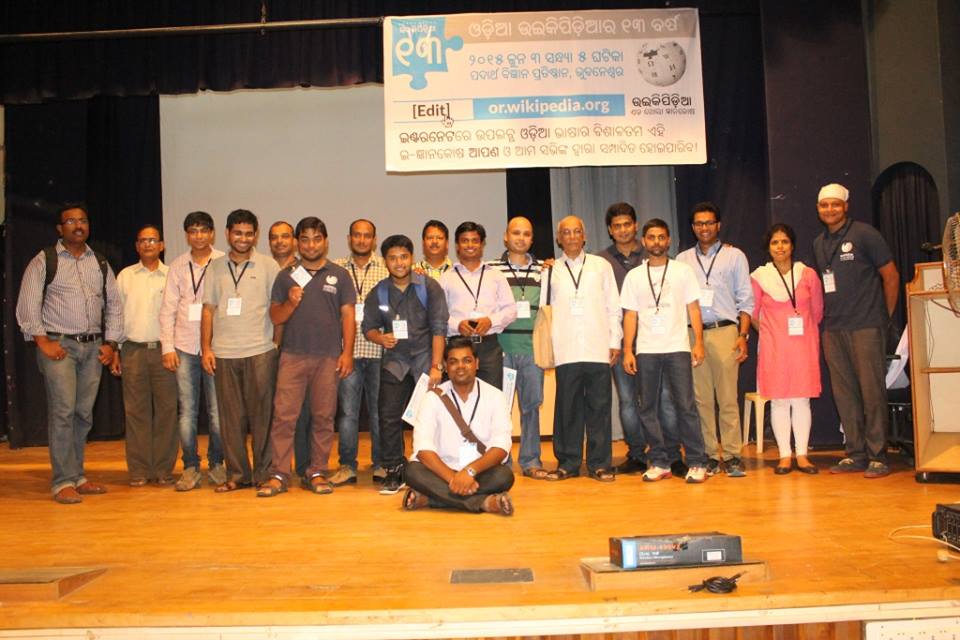
Odia Wikimedians during 13th anniversary celebration, CC-BY-SA 4.0 , Image by Saroj Kumar.jpg

Not only in content part, Odia Wikimedians has also helped in creating a Unicode converter for Odia language which converts non-Unicode texts into Unicode. Wikimedians are also trying to develop an open source OCR and free fonts for Odia language.

Odia Wikipedia has always supported volunteers from different age group and of the different gender to contribute in it. With 72-year-old Wikimedian Dr. Subas Chandra Rout (a very active Wikimedian and has written highest number of medical science  related article on Odia Wikipedia) to 15 years old Satyabrata Sahoo, all have contributed from their part for the growth of Odia Wikipedia.

Odia Wikipedia has also bridged the gender gap with 10 active female contributors, from Pankajamala Sarangi (The most active Wikilibrarian) to Aliva Sahoo(Having articles in top 10 longest articles list). Odia Wikipedia has a 60:40 male, female contribution ratio.

Challenges ahead

One of the major challenges of every Wikimedia project is Editor retention. It is a major challenge for Odia Wikipedia as well. Most of the Wikimedians are volunteers to the project and contribute on their own will and it’s difficult to force them to contribute to Wikipedia.

Awareness is also a major challenge for Odia Wikipedia, from past few years activities Odia Wikipedia was  able to reach towards central and coastal part of Odisha. The community has to reach toward every part to spread awareness about the importance of digitization of language.

Content acquiring and content sharing is also one of the major challenges for Odia Wikimedians, Availability of content in Odia language is very less and most of them are copyrighted. Being an Open source platform Odia Wikipedia never allows copyrighted  content in it. The community has to share and spread awareness about Open source and Open Access with Odia Wikipedia.

With achievements and challenges, Odia Wikipedia is increasing step by step to provide the free resource to everyone and avail the sum of all human knowledge in Odia.

My journey as a Wikimedian.

My journey as a Wikimedian has a lot of twists and turns, It started while reading an article about Bangladesh Liberation war on English Wikipedia. My 10th board exam (2012) was just ended, so I was busy in reading some articles on Wikipedia, and while reading that article by mistake I clicked on India (Intra-Wiki Link), it took me to India article on Wikipedia and I started reading India article, while coming down I found that there is Odia written on the left side of the article, I was surprised to see that and then I clicked on that too.  

Odia written on the left side of the Wikipedia page.


After clicking on the Odia it took me to ‘’’Bharata’’’ article on Odia Wikipedia, As a reader, I had always copied, pasted Wikipedia article and turned it into my  

Assignments, but this was the first time I got to know that there’s an Odia language Wikipedia. Curiosity increased in my mind, then I started clicking some more buttons and found that there’s a site banner inviting readers to be a part of the 2nd Bhubaneswar workshop which was on 1st April 2012.

I registered in that form, following the steps I created an account on English Wikipedia and edited Bhubaneswar article, which was reverted in very few seconds. On 1st April, I went to attend the workshop then I was just 15 years old and I was scared to enter the room as I found that there are many people older than me, My father forcefully insisted me to participate and I attended the workshop. That time, I was surrounded by lots of enthusiastic language lovers and I was the only one who had studied Odia till class 4. Then after my community members had always encouraged me to take part in community activities, whether on Wiki or off wiki.


My first Wikipedia workshop


Subhasish, Mrutyunjay , Aditya made me a good Wikimedian, They have always helped me in this movement, and taught a lot on solving my mistakes and letting me know more about Wikipedia editing. I have helped in organizing many Odia Wikipedia celebration events from 2013 to 2015 and has also organized workshops for Odia Wikipedia. I initiated three major edit-a-thons in Odia Wikipedia; “Women’s day 2015, “Women’s day 2016” and “Nabakalebara edit-a-thon 2015” (https://or.wikipedia.org/s/toq) and a photograph contest in commons for getting Rathyatra images. I had also got chance to represent Odia Wikipedia in two events by Google (Google I/O extended , Google Dev Fest) at Bhubaneswar, I was also invited as a speaker to Perception 2015 by CET , Bhubaneswar and first Open Access India meetup at Kolkata to speak about “Wikipedia and Use of Wikipedia in an Education program. 

First day at the Wikipedia workshop


Until January 2015, I was just an editor to Wikipedia projects and after attending 10th Bengali Wikipedia conference and Train the Trainer, Bangalore by CIS-A2K I started working actively on most Wikimedia projects.


During BNWiki10, Vishnu invited me to attend TTT 2015 and attending TTT had changed my journey in a different way, I got to know about How to work with the community, GLAM projects and lot more.

Odia Wikipedians with the participants of IIMC education program.


I was introduced to Wikimedia India during TTT 2015 and Ravi also played an important role in my journey, He trusted in me and made me a part of Wiki Loves Food and organizing committee of Wikiconference India 2016 as well. During Wiki Loves Food 2015, we used to work a lot for getting good Images on Wiki commons. Our team effort helped in getting 10,000+ CC By-SA images on Wikimedia Commons. Ravi stayed with me while attending Odia Wikipedia’s 14th anniversary and shared a lot of information about the Wikimedia movement and his journey. I will always say that He’s a great inspiration for me. 

Participants from different Indic language Wikipedias during Bengali Wikipedia’s 10th-anniversary celebration.

In December 2015, I joined as a Program Associate at Centre for Internet and Society’s Access to Knowledge program (CIS-A2K), I was coordinating with CIS since 2013 after Vishnu’s visit to Odia community, but this time, I joined CIS-A2K as a staff for a 3-month contract. During these three months, I did two Workshops at two different places and has succeeded in engaging at least 30 Wikimedians in different Wikimedia projects. A workshop at Puri, India helped in bringing 20 new Wikimedians by doubling the active editors of Odia Wikimedia community. A few new articles related to science and technology have been created and many have been enhanced. I have also mentored these Wikimedians to form an informal group called WikiTungi Puri. I am working with this group to make Odia Wikiquotes a live project. After formation of new WikiTungi (Community-based Wiki Clubs) at Puri, with the help of Bhubaneswar Wikimedians, we revived Bhubaneswar WikiTungi. 

Participants of Train the Trainer Program.


I have also helped in bridging the gender gap in Odia Wikipedia by engaging 8 female editors and involving them in Wikimedia activities. 

In global movement, I would like to thank Sameer, He introduced me to Anna and Wikipedia Education Program. I also got involved in Wikipedia Education Program newsletter team and has successfully distributed 2 newsletters.

This was my brief journey in this movement in last 4 years, I might have missed some more wonderful experiences and people, but I hope to continue in this movement and gather more memories.